Embroidery Techniques Guide: Hand and Machine Embroidery Explained

What Is Embroidery?
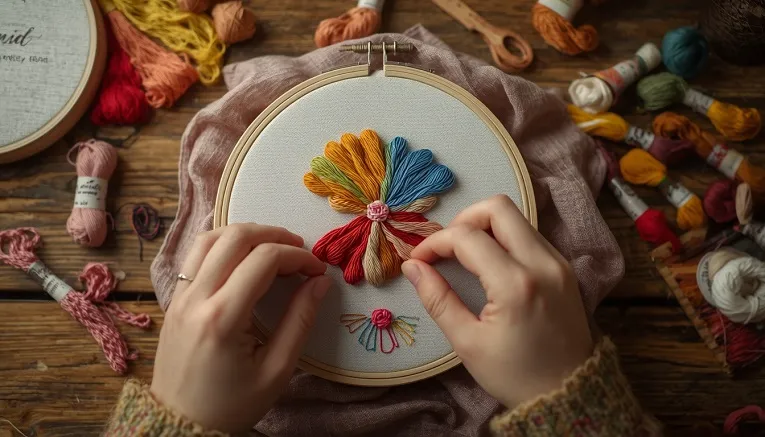
Embroidery is the craft of decorating fabric with needle and thread. It creates patterns, pictures or text on a surface. People do this by hand or with a sewing or embroidery machine. It is one of the oldest decorative textile crafts. In fact, nearly every culture has practised some form of it throughout history.
Main Categories of Embroidery Technique
Surface Embroidery
This is the most common form of hand embroidery. It involves stitches worked directly onto the fabric surface. Backstitch, chain stitch and satin stitch all fall into this category. More advanced subtypes include crewelwork and stumpwork.
Counted-Thread Embroidery
This technique works by counting the threads of an even-weave fabric, such as linen or Aida cloth. As a result, it creates precise, symmetrical patterns. Cross-stitch and blackwork are the best-known examples.
Cutwork and Openwork
Here, sections of fabric are cut away first. Then the raw edges get reinforced with stitching. This creates a lace-like, semi-transparent effect. Broderie Anglaise is a well-known form of eyelet-based openwork.
Appliqué
In this method, small pieces of fabric are stitched onto a base fabric. Together, they build up a design. Many embroiderers finish the edges with decorative stitching for extra texture and dimension.
Machine Embroidery
Machine embroidery splits into two types. The first is hand-guided, or free-motion, stitching. The second is programmed digital embroidery run from a design file. Modern machine embroidery allows for highly consistent, repeatable designs. It works at a much faster pace than hand stitching.
Popular Hand Embroidery Stitches
| Stitch | Best Used For |
|---|---|
| Backstitch | Fine outlines and lettering |
| Satin stitch | Filling in solid areas of colour |
| Chain stitch | Bold outlines and decorative borders |
| Cross-stitch | Counted-thread patterns and pictures |
| French knot | Small raised dots and textured detail |
Hand vs Machine Embroidery
Hand embroidery is slower and more labour-intensive. However, it offers full creative control. It also gives a texture that is difficult to replicate mechanically. Machine embroidery trades some of that individuality for speed and consistency. It can reproduce complex designs accurately at scale. For this reason, it suits commercial and bulk projects well.
Choosing Fabric for Embroidery
For Counted-Thread Work
Even-weave fabrics such as linen or Aida cloth are essential here. This is because the technique relies on counting individual threads accurately.
For Surface Embroidery
Smoothly woven cotton or cotton-linen blends work well. They provide a stable, easy-to-stitch base. This suits beginners and experienced embroiderers alike.
For Delicate or Sheer Designs
Lightweight fabrics like fine cotton lawn or silk organza suit shadow work and openwork techniques. In these cases, the fabric itself contributes to the finished effect.
Traditional Embroidery Around the World
Many regional embroidery traditions carry deep cultural significance. Examples include Indian zardozi metal-thread work, English crewel embroidery, and Chinese silk thread embroidery. These techniques often connect closely with handloom weaving traditions. For more on this wider craft heritage, see our Handloom Textile Heritage Guide.
Caring for Embroidered Fabric
- Handwash gently, or use a delicate machine cycle inside a mesh bag to protect stitching
- Avoid wringing, since this can distort embroidered threads and pucker the fabric
- Iron embroidered pieces face down on a padded surface to protect raised stitching
- Store flat or rolled rather than folded, to avoid creasing directly across a design
For a full fabric care routine, see our Textile Care & Conservation guide.
Common Embroidery Myths
Machine embroidery always looks less authentic than hand embroidery. This is not quite true. High-quality digital embroidery can closely replicate the look of hand stitching. Both techniques have their own distinct strengths.
You need expensive equipment to start embroidering. Actually, hand embroidery only requires a needle, thread, fabric and, ideally, a hoop. This makes it one of the most accessible textile crafts to begin.
Frequently Asked Questions
What are the main types of embroidery?
Surface embroidery, counted-thread work, cutwork and openwork, appliqué, and machine embroidery are the main broad categories.
What is the easiest embroidery stitch for beginners?
The backstitch and running stitch usually come first. They are simple to learn and widely used across many designs.
What fabric is best for cross-stitch?
Aida cloth is the standard choice. Its clearly visible, evenly spaced weave makes counting threads straightforward.
Can embroidery be done on any fabric?
Most woven fabrics can be embroidered. However, stretch fabrics generally need a stabiliser to prevent puckering and distortion.
Related Reading
Written by the Textile Conservancy editorial team, dedicated to helping readers understand fabric, care for it properly, and make more sustainable material choices.